Nearly
thirty years ago, within a short period
of time, I was shown two bottles marked "soda".After much
research and study, I determined they were not soda of the
carbonated type. The first bottle was clearly embossed
"soda" on one side with the letters "SAL." and some
undetermined letters on the reverse side. The bottle
was a flattened oval shape resembling a thin-walled flask with rings
traveling up the sides, a heavy flared lip, and bar pontil,
as pictured below.
I concluded that this was not a soda bottle and
may have been for the chemical Sal Soda, also known as
washing soda or soda ash, a popular product during the early
1800s.
The second bottle was was embossed "Soda Charmant."
This bottle in no way looked like a soda bottle. It
was pontiled, quart sized, pyramidal or teepee in shape,
sided, and had a crudely applied ring lip. Quart sized pontiled soda bottles are almost non-existent
and there is only one other pontiled teepee shaped soda
bottle, which is also sided: the C. Alfs bottle from
Charleston, South Carolina.
One thing that is almost certain is that this bottle was
made at the Lockport Glass Works in Western New York.
Research with a focus turned up nothing at the time and I
tried many times over the years since with no luck. I
concluded that this likely was not a soda water bottle.
Surprisingly both these bottles came back to my attention
at almost the same time, even though it was over 30 years
since I had seen either. The flask shaped bottle came
via an email from a old bottle friend, who was cataloguing
it for an auction house in Virginia. I am sure it was
the same bottle I had seen before, long buried in a old
collection. The teepee bottle showed up on Facebook.
I could not find anything on the flask shaped bottle, but
surprisingly, I did find something on the teepee bottle.
I found two references. The first was in the Buffalo
Morning Express on June 18, 1847:
"SODA CHARMANT."--A stranger yesterday afternoon
left in our office a brace of glass pyramids each capped
with a cork tied by a string around the neck, and
evidently contained something of a liquid nature and
which some pains had been taken to confine. A Yankee's
curiosity is never satisfied until he has looked for
himself, and so we commenced a careful examination, with
an interest not entirely unlike that with which STEPHENS
surveyed the ruins of Central America, and our eye
caught in legible characters around the base of the
mysterious pyramids--"SODA CHARMANT." We began to
comprehend, we supposed what this meant, and cut the
gordian knot, when out popped Mr. cork and fourth came a
gurgling stream of the most delicious beverage
imaginable--That is, provided the weather was suitable
and one was right dry. The name W. ELMER accompanied
the pyramidal, cork-capped containers of good drink, and
if we only know where he lived, we would direct our
friends to go and buy it.
The second was was from the Buffalo Daily Courier, the
next day, on June 19, 1847:
Mr. W. ELMER has sent us a specimen of "Soda Charmant,"
which is one of the best summer drinks we have recently
experienced.
So Mr. Elmer must have been making the rounds to the
local newspapers passing out free samples to stir up some
interest in is "Summer beverage." But unfortunately as noted
in the first paper, he did not leave an address.
A search of the 1847-1848 Buffalo directory lists a
"William Elmore" was listed as a soda and root beer
manufacturer with a home at 47 Seventh. I suspect Mr.
Elmer and Mr. Elmore were the same person and family records
seem to indicate that both names were used. An
advertisement that appeared in the Buffalo Daily Courier a
week before on June 10th, seems to confirm it was Elmore:
CRONK'S COMPOUND SARSAPARILLA BEER-To the Citizens of Buffalo:--The
unexampled patronage which my "Compound Sarsaparilla
Beer" has met in all other places where it has been
introduced, has induced me to make the effort to
introduce it in this city: and if those who deal in the
different kinds of drink, find it to be worthy of the
reputation it sustains in other places, I have little
fear but their good sense will teach them it is to their
advantage to patronize it.
I wish to have it distinctly understood that this is not a two and
sixpenny operation, which appears to-day and is gone
to-morrow--but if it meets from the citizens of Buffalo, only the encouragement that it merits, they may rest assured they will be supplied
in all future time. I have also made arrangements
with Mr. ELMORE, a gentleman of respectability, to
furnish a superior article of Lemon Beer in connection
with the Sarsaparilla. I am prepared to furnish
any who may require it, references as to my
responsibility to perform whatever I engage to do.
je9t15
W. CRONK.
So it appears that Warren Cronk entered in a business
relationship with William Elmore to open another franchise
for his Sarsaparilla Beer in Buffalo, New York. Elmer
must have been planning this business for some time prior
and had bottles blown at the Lockport Glass Works in the
Spring of that year. In June all of the pieces were in
place and Elmore when around to some of the local newspapers
to drop off samples of his product, hoping for some free
publicity. It appears that the business did not work
out and Elmore disappears.
Well one of the oddball soda bottles identified.
Now I just need some luck on the flask shaped bottle!
Photos courtesy of Glass Works Auctions and Jeffrey S.
Evans & Associates, Inc.
There are a series of Maverick Hutchinson bottles marked
with C. F. Riley and C. F. Riley & Company embossed on them.
These bottles are attributed to the states of Washington,
Oregon, Arizona and California and in some cases multiple
cities in those states. Three members of the Riley
family, in various partnerships, were responsible for these
bottles. There is much conflicting information and
misconceptions about this bottling family which spanned
nearly 70 years of operations across the United States and a
journey that started form Northern Maine to and ended
central and southern California.
To tell the Riley story, we will follow their journey, which
starts with Charles Riley in New Brunswick, Canada and
likely at Saint Stephen. Charles was born on May 23,
1821. Saint Stephen boarders the United States with a
bridge that across the Saint Croix River connecting it to
Calais, Maine. In Calais lived Harriet Scott.
Harriet and Charles were married in about 18441 and resided in
Calais. While there, three children were born: two
daughters: Sarah born about 1845, Frances born about 1847
and one son: Charles Frederick born January 31, 1849.
Soon after Charles F.'s birth, the family moved to Black
Rock, a community just north of Buffalo, New York.
They were listed in the 1850 Census2 there with the senior
Charles being listed as a sailor. Within three months,
the family moved to Buffalo and was recorded again in the
1850 Census3 there, where the senior Charles is listed as a
laborer. The senior Charles is listed in the 1851
Buffalo Directory, but without an occupation.
The family was soon on the move again. This time they
landed in Port Huron, Michigan and it was here that the
family stayed rooted for about a decade. It was also
formative years for the young Charles F. Who made
friends with Thomas Edison, the famous inventor, and Henry
Gage, later a governor of California. The three
remained friends for many years. By the time of the
time of the 1860 Census4, the family appeared to be doing
quite well. Charles senior was working as a brewer,
had $1,300 in real estate, and $300 in personal property.
A second son, George, was born in about 1857. They also has an Irish servant,
Anna Hawkins, and a boarder, William O. Scott, who was in all
likelihood a relative of Harriet.
The question is: where did a sailor and laborer learn the
art of brewing? Perhaps, as was a common in the
upper parts of New England and New Brunswick, there was a
tradition of families brewing spruce and other small beers.
Or perhaps he was a laborer at a brewery or small beer
manufacture.
For whatever reason, the Riley Family moved to the Saginaw
area within a year or two of the 1860 Census. There
was a lumber boom going on in Saginaw at that time. A
son Louis Leon was born there about 1862. Father Charles
was listed as a millwright in East Saginaw in the June of
1863 Civil War Draft Registration. In November of
1864, Charles, now in Saginaw City, paid tax of $25 for six
months of being a retail liquor dealer. In the 1868
Saginaw Directory, he is listed as a carpenter on German
Colony road. It appears that during this time son
George died and by 1870, the family continued to reside in
Saginaw City and Charles senior was back to brewing small
beers according to the 1870 Saginaw Census. Charles
appears to have accumulated $500 in real estate and $200 in
personal property. Son, Charles F. was now 21 years of
age and was listed as a laborer. Perhaps he was
working for his father brewing small beer. The 1873
Saginaw Valley directory shows that family continued to
reside on German Colony Road with Charles senior continuing
as a brewer.
The Riley family was about to make another epic move from
one lumber center to another in about 1875 or early 1876.
Both Charles and Charles F. were listed as root beer
manufacturers in the 1876 Seattle directory on Sixth between
Cherry and Columbia and in the June
24, 1876 Puget Sound Dispatch, Charles Riley advertised his
Celebrated Root Beer. In December of that same year,
Charles F. was was in his first advertised billiards match,
a skill he retained and was involved with for the rest of
his life. These events were for high stakes and were
held a larger venues that charged admission for spectators.
The business continued into 1877 as documented in the
September 10, 1877 edition of the Seattle
Post-Intelligencer:
SODA WATER--We paid a visit yesterday to the bottling
establishment of C. Riley, situated in the rear of
Wusthoft & Wald's hardware store, where he puts up soda
water, root beer and ginger ale. He has just received a
new and elegant set of machinery for making soda water
from the factory of Wm. Gee, of New York, which is
capable of being run up to a pressure of 220 pounds to
the square inch. He will serve customers at the lowest
living prices.
For the 1878 bottling season, Charles Riley set up and
agency in partnership with A. F. Learned in Port Townsend
and the local papers touted their ginger ale. His soda
works was known as the Puget Sound Soda Factory.
Charles Riley was also listed as a soda water manufacture in
the 1879 Seattle Directory on Front Street.
In October of that same year Charles F. traveled from
Seattle to Portland to challenge the Portland billiards
champion, Josh Davis, to a competition. Soon after,
Charles must have sold the business in Seattle and moved the
rest of the family to Portland and where he went to work for
Cottle. Post & Company. In the 1880 Portland Census,
Charles and Charles F. were listed as soda water
manufacturers. Charles F. continued to participate in
billiard exhibitions in Portland, with the public willing to
pay to view the masters in action.
1881 was a pivotal year for the family and they spit up.
Charles F. moved to Tombstone, Arizona Territory, to
establish the Pioneer Soda Works. He is listed in the
1881 Tombstone directory and also registered to vote on
December 12th. This time it was not a lumber boom town, but a silver
one that the younger Riley was chasing. Tombstone grew
from nothing to a small city during 1881, with three soda
water factories started in that year. It appears that
the earliest C. F. Riley Hutchinson bottle that is only
embossed with his name in an arch and comes in blue and
several other colors was used at this time. Meanwhile
back in Portland, according to Ron
Fowler in Ice Cold Soda Pop 5c, Charles established the
Pacific Soda Works in Portland that same year, 1881, in
direct competition with his former employer.
1882 was another year for change for the Rileys in both
Tombstone and Portland. In Tombstone, Louise Berger,
the wife of Edward Berger, a saloon owner, made a
declaration of "Sole Trader" in the Tombstone Weekly Epitaph
on February 2, 1882. A few days later on March 1st in
the Cochise County Record, Charles Riley sold part of his
business to Louise Berger for $800 and the firm was named
Riley & Berger. At some time later, Louise's
husband Edward joined the firm. This partnership did not last
very long and was dissolved on September 4, 1882 as
advertised in the Tombstone Weekly Epitaph:
TOMBSTONE, Cochise County, Arizona,
September 4, 1882.
THE FIRM HERETOFORE EXISTING under the firm name or
style of RILEY & BERGER is hereby dissolved by mutual
consent. Charles F. Riley is to collect all accounts due
said firm and to pay all of its indebtedness.
LOUISA BERGER,
E. BERGER,
C. F. RILEY.
Dated September 4th, 1882
Meanwhile, back in Portland, Charles and his youngest
some Louis had moved back to the Seattle area and in June of
that year had made plans to open a "soda-water and cider
factory in New Tacoma" under the name of Chas. Riley & Son.
as reported in the Seattle Post-Intelligencer on May 6th,
1882. Their machinery arrived about August 22nd as
reported in the same paper. This enterprise did not
appear to last very long.
In 1883 more shifts and travel were in the works.
Louis left New Tacoma and traveled to Tombstone to join his
brother in the Pioneer Soda Works under the firm of C. F.
Riley & Company. The brothers were reunited and soon
they would reunited with their parents.
The family, Charles and Harriet, Louis and his wife, and
Charles F., met up in San Francisco and took the
steamer City of Chester to Eureka on October 1, 18846.
As reported in the The Times Weekly Telephone on
October 25, 1884, Harriet A. Riley, Charles senior's wife
purchased two lots in
Clark's addition for $600. In less than two months later on
December 30, 1884 in the same paper, C. F. Riley & Company
announced the opening of the Eagle Soda Works at the corner
of B and Cedar streets in Eureka. Their advertisement was
adjacent to that of the Monroe's Soda Factory, operated by
J. P. Monroe and established by his father A. Monroe many
years before. The Times Weekly Telephone stated:
Attention is called to the advertisement of C. F. Riley &
Co., of the Eagle Soda Works. They keep on hand all kinds of
sodas and syrups, also ginger ale and cider. We have sampled
some of the latter and it is fine. There are now two firms
in this city manufacturing soda, etc., but there is room for
both.
A group of outsiders trying to compete
with a long established local firm proved a strategic
mistake, even though the above paper thought otherwise.
The family was on the move again.
The family ended up in San Bernardino, California and
reestablished their Eagle Soda Works there in 1886 under the
name of C. F. Riley & Company on Arrowhead avenue. The partners were
Charles F. and his father Charles. Louis was also
associated with the firm. In the November 4, 1886, the "San Bernardino Daily
Courier" announced:
Mrs. Mary Gasper and Chas. F. Riley were
married last night in this city by the vulnerable high
priest of Hymen, Justice J. T. Knox. Numerous
friends and connections were present to felicitate the
fortunate pair upon the consummation of their desired
happiness. The COURIER joins the rest in wishing
them all possible felicity.
A few years later in 1889, the family was to split again.
In June of this year, Charles Riley purchased three lots,
nos. 34, 35 and 37 of the Leach & McIllvain addition, in San
Jose, California and soon after started the Eagle Bottling
Works (not Soda Works) under the firm of C. Riley & Company.
(not C. F.) at 613 South First. The partners were
Charles and his son Louis. Son Charles F. Riley
continued to operate the Eagle Soda Works in San Bernardino,
now at 290-292 Third street. By 1892, C. Riley &
Company, had moved to 691 Minor near Home.
In late 1895 or early 1896, there must have been a
falling out and Charles senior had full control of the firm
and son Louis was listed as an employee of Charles Riley and
not a partner. This situation continued until 1899,
when Charles Riley appears to have retired and son Louis
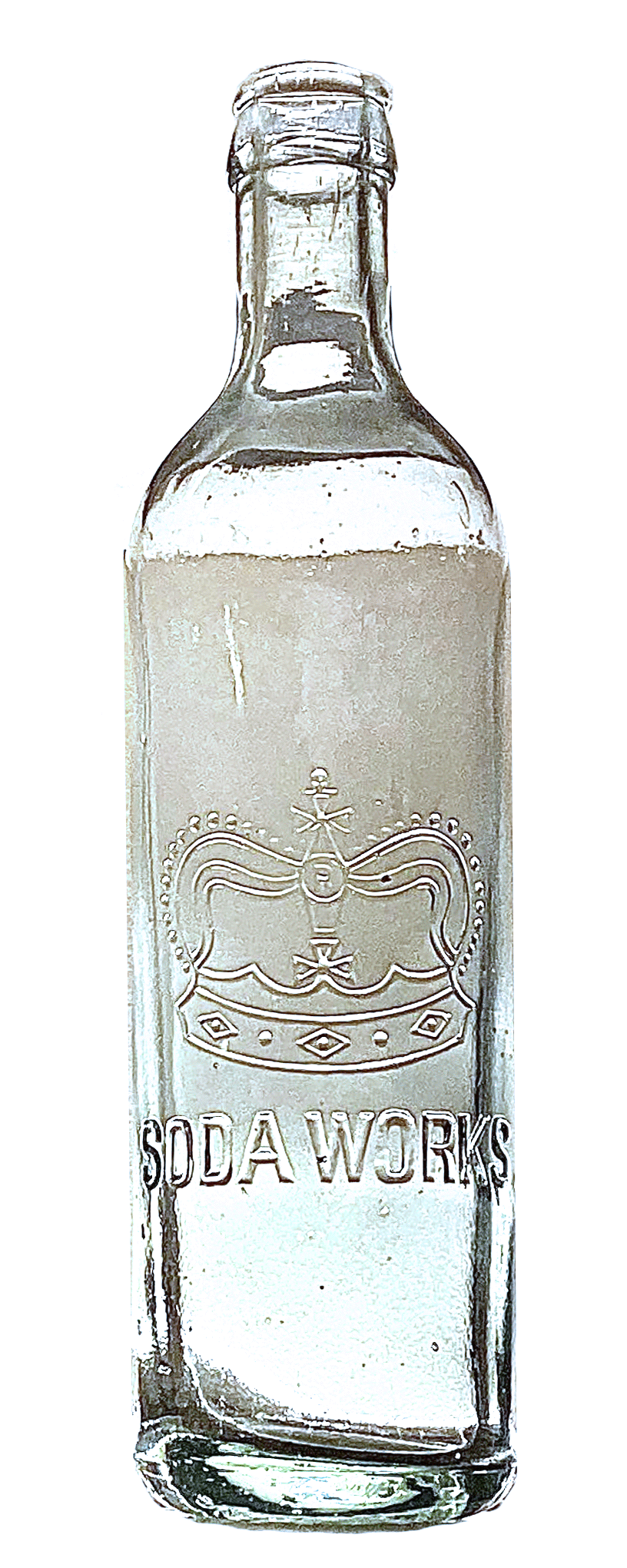
took control of the business and renamed it the Crown Soda
Works. The bottles used by this new firm used their
namesake of Crown Cork and Seal closure.
Meanwhile back in San Bernardino, C. F. Riley started
building a new bottling plant as reported by the San Bernardino County Sun
on November 11, 1901: "Workmen are at work on the foundation
for C. F. Riley's new soda and bottling works, on the west
side of G street, south of Third. The building is to be
30x76 feet, and will be completed on January 1." The
San Bernardino Daily Times reported on December 7, 1901:
"a building for C. F. Riley to be occupied as soda works to
cost about $1350." Charles F. continued to operate the
Eagle Soda Works now at 364 G Street once the building was
completed.
Harriet A. Riley, the mother died on August 13, 1902 at
the age of 76 years old and was followed by the death of her
husband Charles Riley on February 18, 1903 at the age of 81
years old.
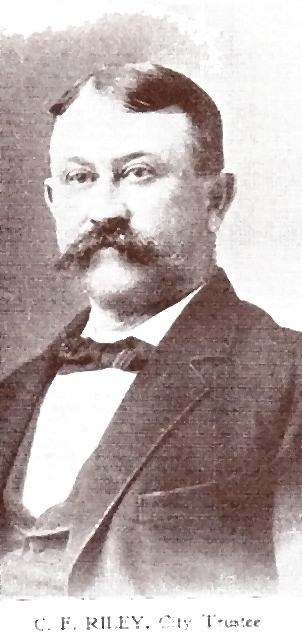
During his time in San Bernardino Charles F. Riley was
quite active. The was described as being 5' 3 1/4"
tall with blue eyes with a birth mark on his right cheek5.
He was one of the signers of the San Bernardino city
charter, was a member of the City Council and its mayor from
1905 to 1907, after which he served as a trustee6.
Unexpectedly, in July of 1910, Charles F., after 30 years
operating bottling businesses, sold the Eagle Soda Works to
Alfonso C. Shackford and T. J. Starke as documented in the San Bernardino County Sun on July 24, 1910:
A combined business and property deal was
consummated Thursday when C. F. Riley sold ou his soda
water business and leased the property on which it is
located to Alfonso C. Shackford and T. J. Starke, both
of this city, the consideration being $15,000. The lease
will run for five years.
Charles F.'s brother Louis continued to operate a
bottling business in San Jose until 1927.
Charles F. Riley died on February 8, 1928 in San
Bernardino, California. Louis L. Riley died on October
10, 1940 in San Jose, California.
Cloverleaf Soda Co. 1928
Some observations. Charles Riley does not seem to
have believe in marking his bottles. One would have
suspected that he would have had impressed stoneware small
beer bottles form his time in Port Huron and Saginaw City
Michigan. There are no soda bottles embossed with his
name during his time in the Seattle, Portland, or in New Tacoma, with
his partnership with son Louis. Charles F. seemed to
be the opposite and once on his own, immediately started
using embossed bottle. When Charles F. was the lead
partner with is Father, there are embossed bottles, but
after they split, the embossed bottles are eliminated.
Once Louis was in control of his own business, he started using
embossed bottle in 1899
and thereafter. The below chart maps the bottles to
the firm, location and bottles or no bottles:
Location
Firm
Bottle
Port Huron, Michigan
Charles Riley (-1860-1861)
No Marked Bottles
Saginaw City, Michigan
Charles Riley (-1870-1874+)
No Marked Bottles
Seattle Washington
Charles Riley (1876-1879)
Puget Sound Soda Factory
No Marked Bottles
Portland, Oregon
Charles Riley (1881)
Pacific Soda Works
No Marked Bottlers
Tombstone, Arizona
Charles F. Riley (1881-1882)
Pioneer Soda Works
New Tacoma, Washington
Charles Riley & Son (1882)
No Marked Bottles
Tombstone, Arizona
Riley & Berger (1882)
Pioneer Soda Works
No Marked Bottles
Tombstone, Arizona
C. F. Riley & Co. (1883-1884)
Pioneer Soda Works
No Marked Bottles-Note that the the firm was the
Pioneer Soda Works and not Eagle Soda Works as
embossed on later bottles.
Eureka, California
C. F. Riley & Co. (1884-1885)
Eagle Soda Works
San Bernardino, California
C. F. Riley & Co. (1886-1889)
Eagle Soda Works
San Bernardino, California
Charles F. Riley (1889-1910)
Eagle Soda Works
San Jose, California
C. Riley & Co. (1889-1895)
Eagle Bottling Works
No Marked Bottles-Note that the the firm was the
Eagle Bottling Works and not Eagle Soda Works.
San Jose, California
Charles Riley (1896-1898)
Eagle Bottling Works
No Marked Bottles
San Jose, California
Louis L. Riley (1899-1927)
Crown Soda Works
Photos courtesy of American Bottle Auctions and the FOHBC
Virtual Museum.
About a year ago, Danielle Kreeger showed me a bottle in the
soda and beer bottle category that was new to me. It
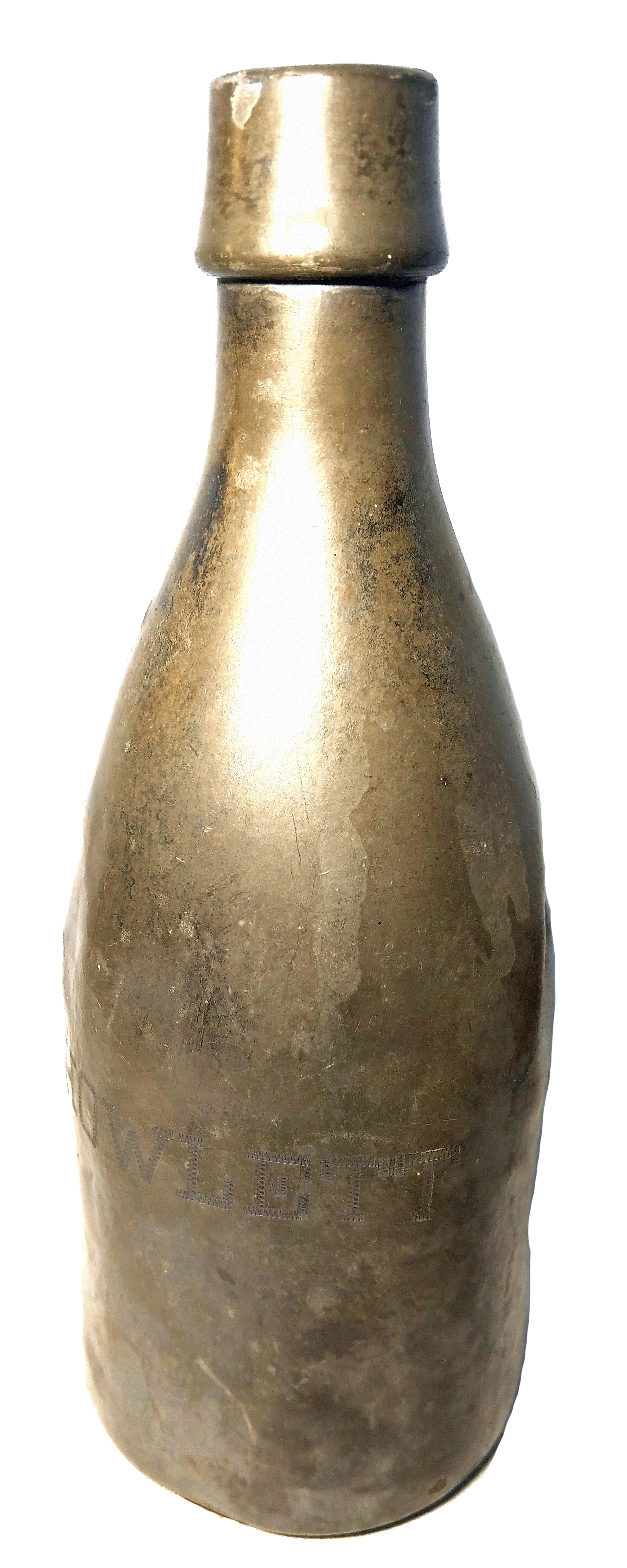
was what appeared to be a metal beer bottle with the name
"JOHN HOWLETT"
engraved upon it. She found it in the Philadelphia area.
Although I had seen metal fruit jars, whiskey flasks, acid
bottles and even a medal medicine bottle, I have never seen
a metal beer bottle. Since this was hand engraved, I
suspected it was a one off piece.
Looking for information on John Howlett, I first checked my
directory listings to see if there were any brewers or
bottlers with that name. I found none. Next, I checked
the other historical records and I found there was a John Howlett, who was a metal worker in Philadelphia. He
was born in Lancashire, England on October 24, 1877 to John
and Elizabeth (Mills) Howlett. Soon after, in 1878,
the family moved to Wilmington, Delaware, where John Howlett
senior, worked as a carder in a textile mill and later was a
foreman at the Franklin Mills. John, junior, was
married to Jennie McClelland in 1895 according to census
records, but appears to have officially been married on
December 28, 1909 in Wilmington. The couple had
six children: John (1896), Elizabeth (1903), Thomas (1906),
Ethel (April 28,1910), Russell Joseph (September 16,
1914-July 27, 1915), and Mildred (1917).
John was listed as a "core maker" in the 1900 Philadelphia
census. The 1901 Philadelphia Directory lists Jno. S.
Howlett as a moulder at 2847 Ruth Street, which matches the
1900 Census entry. He was again listed as a moulder in
the 1910 Philadelphia Census, as a "core maker" in the 1920
Philadelphia census, a moulder in the 1930 Philadelphia
Census, a moulder in the 1940 Philadelphia Census, and
listed as not working in the 1950 Census . His World War I
draft registration card indicates that he was a "Moulder" at
the Midvale Steel Company and several of his Census records
mention steel foundries, mills or works.
Midvale Steel Company manufactured various steel products at
the turn of the 20th Century, but there specialty was steel
casting and machining small steel canisters, including steel
casings for munitions. It doesn't take much
imagination to see John and his co-workers making bottles
for themselves, just as glass workers made hats, pitchers
and other glass whimsies.
John died on October 10, 1959 in Atlantic City according to
the Philadelphia Evening Bulletin on October 12, 1959
and was buried in the Oakland Cemetery in Philadelphia.
But this write-up is really not about a metal bottle, it is
a tribute to the fellow and highly respected Philadelphia
soda and beer bottle collector who showed me this unique
bottle. Danielle revealed this bottle to me at the July
2025 Shupp's Grove bottle show. I missed the Fall Show in
September, and heard through a mutual friend that she was not
there. This was most unusual for Danielle. A
phone call from her spouse
revealed that she was gravely and suddenly ill. This
resulted in hospitalization and discovery of a rare
complication of Lyme Disease. Danielle bravely
fought the effects of this malady for months, but in the end, it got
the best of her.
Danielle was a PhD and her early work focused on the
physiological ecology of bivalves and evolved into
ecosystem-level science emphasizing the services provided by
foundation species and habitats. While doing research
in England, an unusual low tide occurred in the area she was
studying. She saw people walking out to the exposed
areas and picking up dozens of pottery ginger beer bottles, she follow suit and that was the start of her collecting
journey.
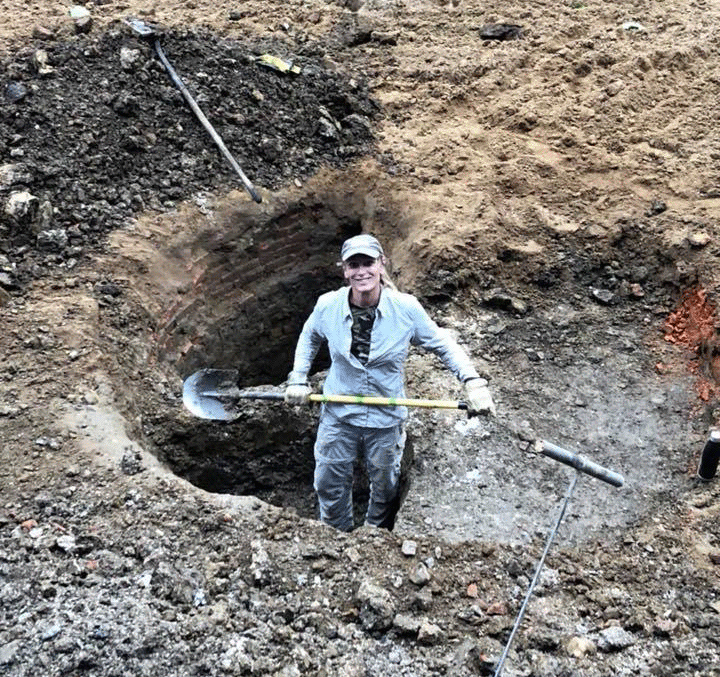
Once back in the United States she started digging bottles
and eventually became an accomplished privy digger.
Years later she started the BottleLand site and was actively
engaged in digging, buying bottles from diggers and
auctions, and selling bottles at shows, on ebay, and on the
BottleLand site.
Danielle, you will be missed by me and the rest of the
collecting community. I am sure you are trying to
explain to Roussel, Heiss, and Riddle why their bottles are
the focus of so many collectors still on this side.
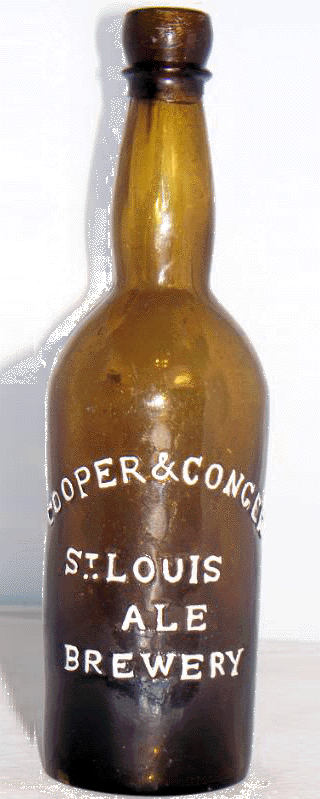
The Cooper & Conger
Saint Louis
bottle has been highly desirable due to its
attractiveness, rarity and association with the treasure
trove of bottles found in the Missouri River.
This bottle became widely
known when two were found on the steamer Bertrand, which
sank on April 1, 1865 in the Missouri River near De Soto
Landing in what was at the time Nebraska Territory.
Her destination was the Fort Benton, Montana Territory, an
entry point to the gold fields. The
Bertrand was found in 1968 and was excavated during 1868 and
1869 and its contents were documented in the book The
Bertrand Bottles A Study of 19th-Century Glass and Ceramic
Containers. There were a number of stoneware and
glass ale bottles recovered from the Bertrand. The
Cooper & Conger bottle were the only glass bottle that
were
embossed. This bottle was described in this book as
follows:
Type 4 ale bottles were blown in two-piece molds and exhibit
a collar-and-ring brandy finish which permitted the corks to
be securely wired in place (fig. 21). The edge of the
base is flat, and the center of the base is a shallow
dish-shaped depression. Blown letters on the bodies of
the bottles read: "COOPER & CONGER / ST. LOUIS / ALE
BREWERY." Remnants of thin silver-colored foil adhere
to the corks and to the necks of these specimens.
Nothing is known of Cooper and Conger St. Louis Ale Brewery
despite a considerable research effort to document the
company. Dimensions: height, 9 1/2 inches; diameter of
base, 2 9/16 inches; diameter of neck (outside), 1 inch,
(inside), 3/4 inch.
This book notes that the ale bottles were found in boxes
of twelve (12) bottles and since the bottles were of various
forms, it is likely that the two Cooper & Conger bottles were second hand bottles on a one way trip to
the goldfields. Being second hand bottles, the Cooper
& Conger bottles were likely old and the firm was no longer
in business.
The researcher of the Bertrand artifacts stated that they
could not find any information on the firm. Perhaps
that were looking for a content in 1865, when they should
have been searching earlier documents. Here is what I
was able to find.
The firm of Cooper & Conger was made up Richard F. Cooper
and William J. Conger1.
Once I knew who they were, I was able to find some
background on the two prior to their partnership in Saint
Louis.
Richard Fenimore Cooper
Cooper was born on May 19, 1834 in Cooperstown, New York,
to Richard Fenimore Cooper and Mary (nee: Storrs) Copper.
A brother Goldsborough Cooper was born two years later on
April 12, 1836. His Father was an attorney of some
note. The family moved to Oswego, New York at some
point during the 1840s, where they were recorded in the 1850
Census. Richard the younger was listed as a 16 year
old scholar. By 1855, the Cooper family returned to
Cooperstown, but the younger Richard was not with them.
His younger brother was listed a 19 year old Student.
What Richard was doing between 1850, when he was a listed as
a "Scholar" and about 1859 is unknown. Same for his
brother starting in 1855, when he was a "Student"
in Cooperstown. The
elder brother must have worked in an ale brewery during the
this decade and saved a considerable of capital. It is
likely his brother followed the same occupation and it would
seem like the brothers worked for the same employer.
But by the start of 1860, the brothers must have been in
Alton, Illinois and operating an ale brewery there.
This is supported by their having an agent in Saint Louis as
advertised in the February 5, 1860 in the Missouri
Republican:
XXX CREAM ALE. The undersigned having been appointed sole
agent for the sale of Cooper Bro's. XXX CREAM ALE in St.
Louis, I am prepared to furnish the trade with this superior
article, in quantities to suit, fresh from the Brewery.
WM. H. HICKOK.
No. 156 North Second street.
The 1860 Alton, Illinois Census list R. F. Cooper as a 31
year old male brewer with $35,000 of real estate and $3,000
in personal property living with one of laborers in a single
unit. His brother is listed as G. Cooper, a 24 year
old brewer living at a hotel or boarding house.
The Cooper Brothers started to advertise heavily, starting in the Alton Telegraph on March 13, 1861.
In the fall of 1861, the Cooper Brothers improved their
brewery during a brief shut down and when reopened resumed
consistent advertising starting with the November
1, 1861 edition of the Alton Telegraph:
THE CELEBRATED COOPER BRO.'S XXX CREAM ALE.--By reference to
an advertisement in another column, it will be seen that
Messrs. COOPER BRO.'S have commenced the manufacture of
their duly celebrated XXX Cream Ale, after a short
suspension to put their brewery in perfect order. This
is good news for those who have a taste for this beverage,
as their XXX Cream and Amber Ales, and Porter are admitted
to be the very best manufacture in the West.
Those who deal with the Messrs. Cooper will find them
accommodating and pleasant to do business with, and that
implicit reliance can be placed in their statements.
The referenced advertisement in the same paper stated that
the products were priced at $9.00 a barrel. Saint
Louis Globe-Democrat November 14, 1861 Cooper bros. 26 1/2
brls ale. Saint Louis Republic November 25, 1861
Port of Saint Louis shipping news "Cooper & Bros 10 half
bbls beef [sic. beer]]. The year was ending on a good
note.
1862 proved to be a disastrous year for the Cooper Brothers.
The year opened with them lowering the price of their "Alton
Cream Ale" from $9.00 a barrel to $7.50 a barrel as
advertised in the Alton Telegraph on January 17, 1862.
Was this reduction due to competition, lower expenses due to
their recent plant improvements, or
were they looking to expand their customer base by offering
a product at a reduced price. They ran this large
advertisement until disastrous explosion occurred at the brewery as documented in
the Saint Louis Republic on February 5th, 1862:
Explosion at Cooper's Brewery
Just as we go to press, we learned that an explosion
occurred at Cooper's Cream Ale Brewery this afternoon,
destroying the whole building and injuring all employed
in the building somewhat. The engineer, Daniel Sullivan,
was injured the worst; he was brought to this city and
his wounds were dressed by Dr. Davis. He states that it
happened from the boiler bursting. We have not any
particulars.--[Alton Democrat.
A follow up article in the Alton Telegraph on February 7,
1862 adds: "The Messrs. COOPER estimate their loss at not
far short of $16,000, and no insurance. It is
extremely doubtful whether the establishment will be
re-built, at least until the termination of our national
troubles." The latter being the Civil War.
The second disaster was a few days later when the
February 14, 1860 Alton Telegraph reported that the property
of R. T. & G. Cooper was seized the sheriff for sale.
The third disaster occurred just over two months later as
reported in the Alton Telegraph on April 25, 1862: "Died of
Typhoid fever, Goldsborough Cooper son of Richard Cooper,
esq. of Cooperstown, NY. "
In two and a half months, Richard F. Cooper lost his
thriving business, his property, and his partner and
brother. He appears to have left Alton for Saint
Louis.
William J. Conger
Conger is a bit of a mystery. A W. J. Conger was
the General Southern agent for the Ohio & Mississippi
railroad in 1860. He was headquartered in New Orleans,
but pops up across the South and Midwest during that year in
various newspapers thru early 1861. He was no stranger
to Saint Louis. A line in the New Orleans
newspaper, The Daily Delta, from May 3, 1861, states
"FOR THE NORTH AND EAST.--A telegraph to Mr. W. J. Conger
says that the connections at Cairo are perfect. No
obstructions are experienced by travels." So during
the early stages of the war, travelers from New Orleans were
able to make there way north. It appears that Conger
had already relocated to a northern city. This was the
last reference as being connected with this railroad.
A railroad between enemy states
was not going to be a thriving business during the Civil War.
In
June 1861 he is at various hotels in Cincinnati listed as
being from New Orleans. In August and October he was in New York City.
Broadway Brewery
The Zoller family was involved in the the brewing
industry during the mid-eighteenth century in Saint Louis. An
E. Zoller dissolved his partnership with C. Blume in the
Rocky Branch Brewery as recorded in the Anzeiger des
Westerns 1/1/1851. A Zoller was involved in
running the Rocky Branch for the next decade. The
brewery was located on North Broadway. The Zollers
were involved in opening another Brewery near North
Broad ways a couple of years later that was known as the
Broadway Brewery. It's location was at 4 Palm Street
on the south side of between Broadway and Second Street in
the northern part the
city. The brewery was established in 1854, according to an article in the
Saint Louis
Republic on July 3, 1859, and at that time was producing
1,100 barrels of lager and 2,500 barrels of common beer.
It appears that John Zeller was an original owner of this
brewery. Later, by 1858, it
was operated by John G. Zoller & Company. The brewery
was associated with a tavern located around the corner on
Broadway. Zoller was in partnership with two others in
operating the tavern. Due to financial
trouble, the partners ended up in court and eventually the property
was sold at sheriff's sale. Prior to this, the control
of the brewery was transferred to John's wife Catherine.
Catherine paid the IRS tax for the brewery in the first
couple of months in 1863, but the volume was low with
between 7 and 12 barrels a month. Obviously, the capacity of
80 and 120 barrels a year was well below the capacity 3,600
barrels produced just a few years prior.
Saint Louis Ale Brewery
In April, 1863, enter Cooper and Conger. Their
relationship is unknown, but perhaps there is a New York
State connection as Cooper was from New York and Conger
ended up there after leaving his agency. Cooper's
father was a widely known attorney in New York. They
promptly renamed the Broadway Brewery to the Saint Louis Ale
Brewery, perhaps as a public reminder of the Alton Ale
brewery that burned earlier. Since the brewery was in
North Saint Louis, which was out of the way, the new firm
established an office at 75 Commercial, (later 313 N.
Commercial) which was between Olive and Locust Streets on
the waterfront and in the center of the business and
shipping district.. The first record of the firm was in the Saint Louis Republic
paper on April 25, 1863, when the partners received a shipment of
12 packages via
the railroad from Alton, Illinois. This was followed
up by IRS tax payments on June 1, 1863, for the prior
month's production, for 221 1/2 barrels of Ale. A
large increase of the scant 7 barrels produced by Mrs.
Zoller during a previous month. On June 17 in the Saint Louis Republic,
a shipment form Alton, Illinois records another shipment of
12 boxes of bottles. As Alton did not have an operating
glass works during this period, so these were likely the
return of empty bottles. Several entries in the
shipping news, indicate that the firm shipped their beer to
Alton, Cairo, and Peoria, Illinois, Memphis, Tennessee, and
New Orleans, Louisiana. Monthly IRS payments continued
thru January 9, 1864 for 199 1/4 barrels of ale and 17
barrels of porter.
Somewhere along the line, William C. Trumpbour was
admitted as a partner. As former
manager of the Saint Louis Theater (1864) and later
proprietor of the Club House (1865), he hardly seems like
someone who would be involved in the brewing business.
The firm received a shipment of 7 packages on December 17,
1863 from Pittsburgh, but the contents were not listed,
however,
this was likely a shipment of bottles. They would soon
be outdated.
In a bizarre sequence of events, the Saint Louis Ale
Brewery changed hands three times in under 45 days.
This rapid series of changes and
the 1864 directory listings confused those who
researched this brewery. What we know is that the firm
of Cooper & Conger was dissolved on January 20, 1864 as
advertised in the Daily Missouri Democrat on January 20,
1864:
THE COPARTNERSHIP HERETOFORE EXISTING
between Richard F. Cooper, William I. Conger and William
C. Trumpbour, under the name and style of Cooper &
Conger, is this day dissolved by mutual consent. Richard
F. Cooper and William I. Conger have disposed of their
entire interest to Wm. C. Trumpbour, who assumes all
liabilities, and who will continue the business at the
old stand, No. 75 Commercial street, in his own name.
W. C. TRUMPBOUR,
W. I. CONGER,
R. F. COOPER.
So for now Trumpbour was now the proprietor of the
brewery. This is supported by the IRS records for the
period. Cooper & Conger made payment for December,
1863 on January 9, 1864 for 199 1/2 barrels of ale and 17
barrels of porter and W. C. Trumpbour made payment for 48
1/4 barrels of ale and 9 barrels of porter, a significant
reduction in production.
Perhaps this reduction in production left Trumpbour in
need of capital, so he apparently brought in a partner or
partners with a new firm under the name of W. C. Trumpbour &
Company. This firm paid the IRS tax for February, 1864
for 337 barrels of ale and 5 1/2 barrels of porter. This
represented a large
increase in production, but it was apparently not enough,
and the brewery was sold again, to B. F.
Young & Company as reported in the Missouri Republican
on March 6, 1864:
ST. LOUIS ALE BREWERY--The undersigned, having
purchased the extensive Brewery lately owned by Cooper &
Conger, intend brewing and keeping on hand a fine stock
of XXX Ales and Porters.
Having secured the services of Mr. Richard Lesllie, a
skillful brewer of New York State we feel confident in
giving satisfaction to all who may patronize us.
Hotels, Saloons, Steamboats and Private Families,
promptly supplied on reasonable terms by leaving their
orders at Depot and Office, N. 75 Commercial street,
between Olive and Locust streets.
B. F. YOUNG & CO.
Successors to Cooper & Conger.
It was interesting that Young does not list his firm as
the successor to Trumpbour & Company, but Cooper & Conger.
The connection to the Alton Cream Ale must have had a good
reputation with the public. Young was in business at this location for the next decade.
Interestingly, an ad in the Saint Louis Republic on March
26, 1865, states that:
Mr. ABRAHAM WOOD, formerly of Pittsburgh, and a veteran
brewer of thirty years' experience, has charge of the
brewery, which alone is a guarantee of the excellence of
their manufacture.
Abraham and his brother Adam, for many years operated a
brewery in Pittsburgh under the name of A. & A. Wood and had
a branch in Saint Louis known as A. & A. Wood & Company,
both of which were dissolved in 1855. Adam has a
marked pontil bottle.
The 1864 Saint Louis Directory lists three of the four
firms that had control of the Saint Louis Ale Brewery, which
has lead to some to think that these firms were operating
separate breweries. The directory listings in the
white pages were as follows:
COOPER & CONGER - (Richard F. Cooper and
William J. Conger,) brewers, office 75 Commercial,
brewery Palm & Broadway. (see adv.)
Young, B. F., & Co. - St. LOUIS ALE BREWERY, proprs., 75
Commercial. (See adv.)
The directory listings in the
yellow pages were as follows:
Breweries.
COOPER & CONGER - 75 Commercial. (See
adv.)
Trumbour, William C. - ST. LOUIS ALE BREWERY, propr., 75
Commercial. (See adv.)
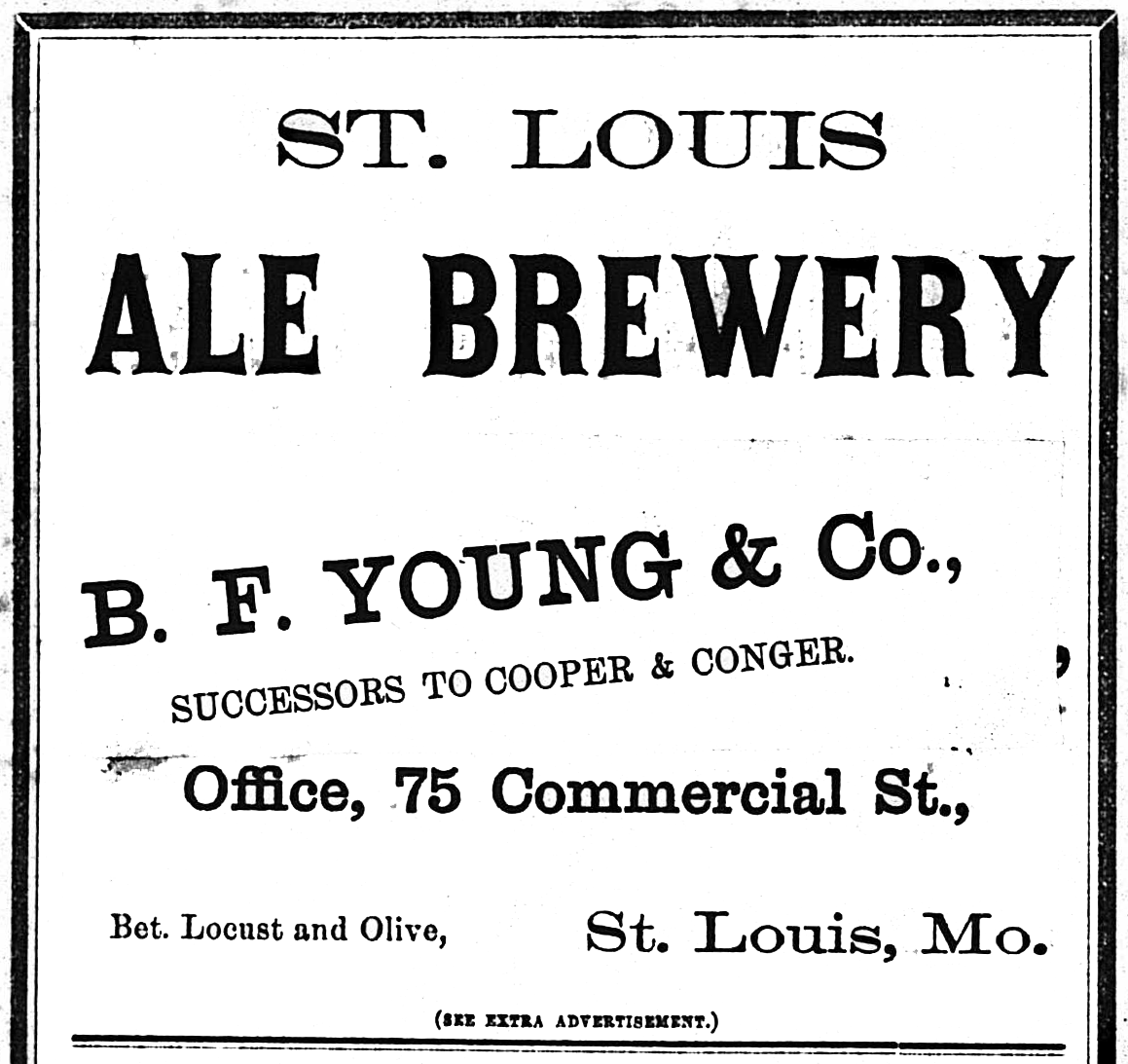
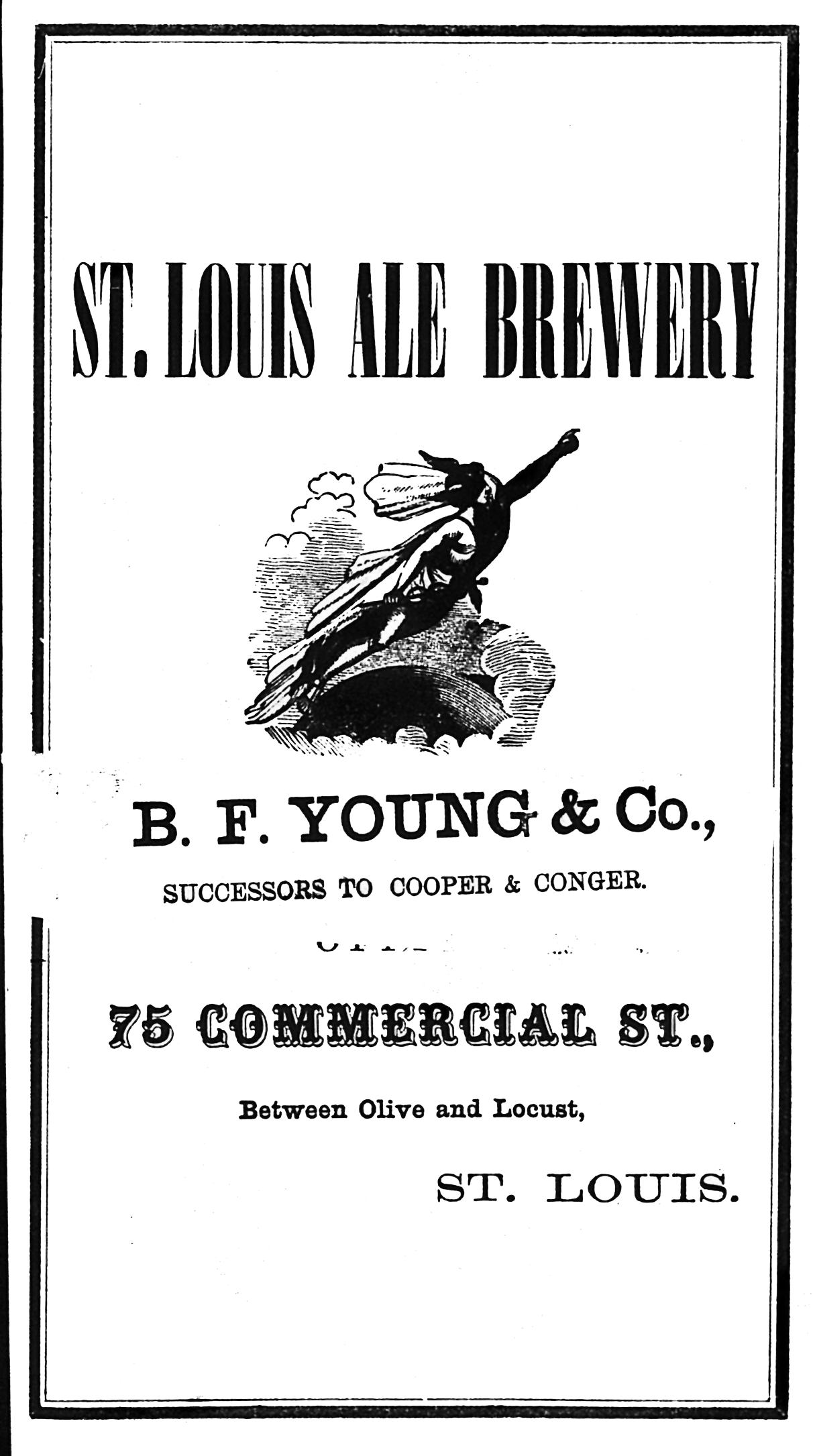
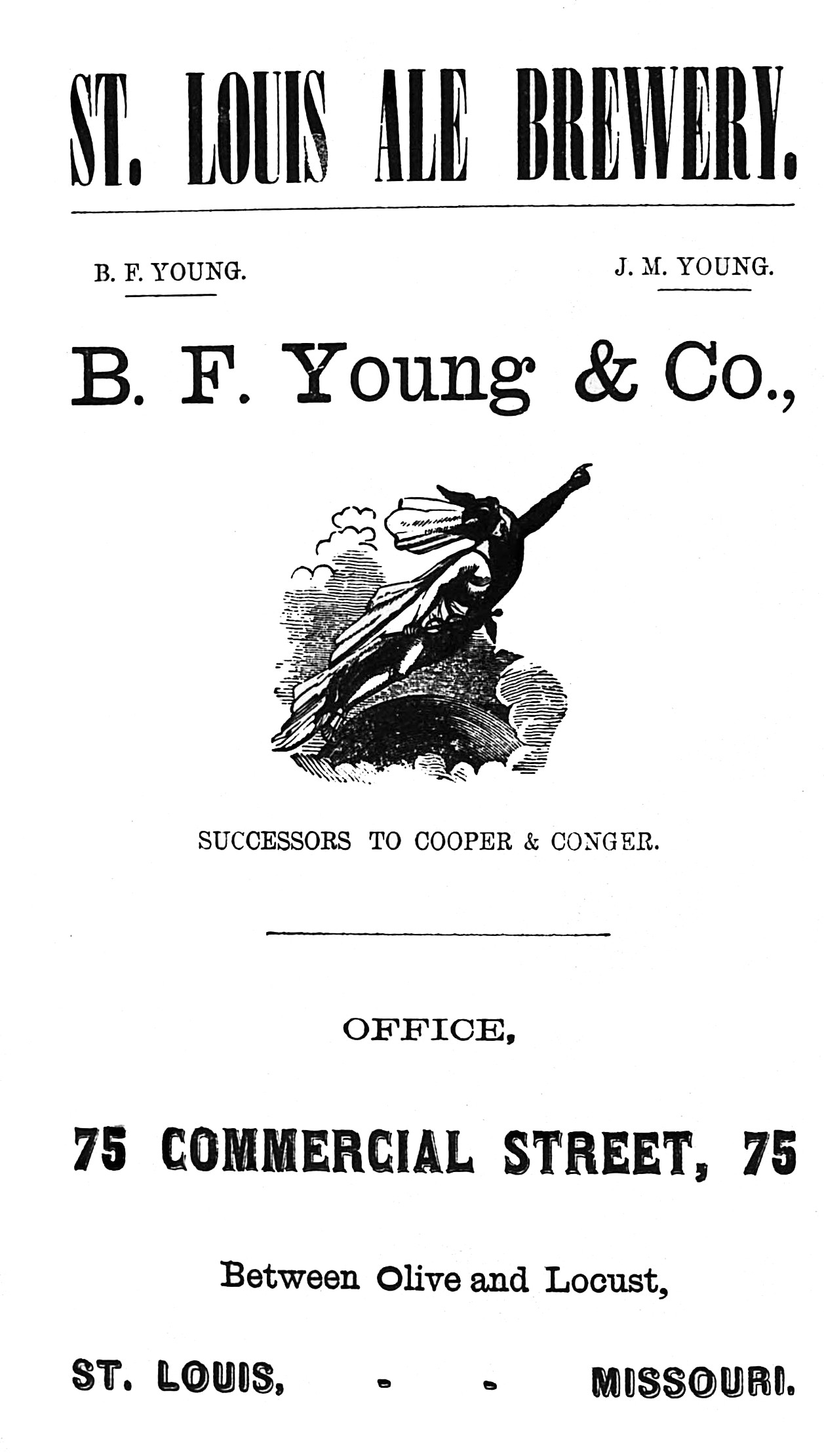
The Advertisements referenced in the above is shown
below. The advertisements for Cooper & Conger and
Trumpbour had the firm names obliterated by a hastily applied
label pasted over their names. This label was that of
the B. F. Young & Company who was the final proprietor.
The fist advertisement was that of Cooper & Conger;
The
Second advertisement was that of W. C. Trumpbour;
And the third was that of B. F. Young & Company.
As can be seen in both the above advertisements, a label
was crudely and crookedly applied over either Trumpbour or
the
Cooper & Conger name. The word office can be seen
peeking out under the label and the label on the second ad
and is
over the border on the left hand side. The first ad was on
page 287 and was to be the ad for Cooper & Conger as listed
in the advertisement index.
After The Partnership
The initial movements of Richard F. Cooper are hard to
follow after the partners sold the brewery. He appears
to have stayed in Saint Louis. He was a witness in a
trial in 1864 as recorded in the St. Louis Globe-Democrat on
January 26, 1864. In February 1865, he was arrested
because he was "engaged in a row with another man whose name
we did not learn, in Bamberger's saloon, corner of Fifth and
Chestnut, last night about 11 o'clock" as recorded in the
Saint Louis Republic on February 13, 1865. In 1866, he was a
member of the firm of Melbourne, King & Co., who were
commercial merchants.
Cooper next shows up in Towanda, Pennsylvania, where with his
younger brother
William S. Cooper, formed the firm of Cooper Brothers in
April of 1869, who
were to manufacture ale and other malt liquors. D.
Archie Pell was a special partner as documented in the
Bradford Reporter on August 19, 1869 as follows:
WE, THE SUBSCRIBERS, HAVE this day entered
into a limited partnership agreeably to the provisions
of the act of Assembly of the Commonwealth of
Pennsylvania, passed the 21st day of March, 1836,
entitled "an Act relative to Limited Partnerships," and
do hereby certify that the name of the firm under which
said partnership is to be conducted is COOPER BROTHERS;
that the general nature of the business to be transacted
is the manufacture of ale and other malt liquors, and
vending the same, and the same will be transacted in the
borough of Towanda, Bradford county, Pa.; that the names
of the general partners of said firm are Richard F.
Cooper and William S. Cooper, both of the borough of
Towanda, aforesaid, and the special partner is D. Archie
Pell, of the City of New York, State of New York; that
the capital contributed by the said D. Archie Pell,
special partner, is eight hundred dollars in cash for
one-tenth interest in said business; that the period at
which the said partnership is to commence is the first
day of April, one thousand eight hundred and sixty-nine,
and that it will terminate on the first day of April,
one thousand nine hundred and Nineteen.
R. F. COOPER,
WM. S. COOPER,
General Partners.
D. ARCHIE PELL.
Special Partner.
Towanda, April 1, 1869.--6w.
This appears to be a short lived business venture.
Next, the 1870 Census has a Richard Cooper aged 40 and born
in New York with his wife Ellen aged 27 in the 11th Ward of
Louisville, Kentucky with an occupation of a brewer.
Soon after, in about 1871, he shows up in Elmira, New
York, as a brewer at T. Briggs & Company and is listed in the
1872, 1873, and 1874 Elmira directories.
Richard F. Cooper died on March 7, 1875 and was buried in
Christ Churchyard in Cooperstown, New York. The
Lebanon Daily News, on March 18, 1875, noted that he was "a
nephew of James Fennimore Cooper, the distinguished novelist
died in Elmira on Saturday last, of consumption."
If the initial movements of Richard F. Cooper are hard to
trace, those of William J. Conger are non-existent. I
was not able to find any reference to him after the partners
went their separate ways.
Conclusion
So there you have it. The Cooper & Conger Saint
Louis Ale Brewery was founded in some time just before April
25, 1863 and was sold on January 20, 1864 and was in
business for only nine months. The bottles were
apparently made in Pittsburgh towards the end of 1863.
This tightly dates this bottle to 1863 only.
So how where these bottles found on a steamship that sank
in 1865? They were likely the property of B. F. Young
& Company, the eventual successors. Bottles of this
type were sold by second hand and junk dealers during this
time period. Using bottles registered to another firm
was criminal, but filling and sending to the distant
goldfields decreased the likelihood that one would get
caught. This is why only two bottles were on the
Bertrand amongst the wide variety of glass and pottery ale
bottles found, suggesting a load of second hand
bottles filled with ale and sent on a one way trip to the
goldfields. Perhaps more can be found there as few
have been found in Saint Louis.






 a Territory, to
establish the Pioneer Soda Works. He is listed in the
1881 Tombstone directory and also registered to vote on
December 12th. This time it was not a lumber boom town, but a silver
one that the younger Riley was chasing. Tombstone grew
from nothing to a small city during 1881, with three soda
water factories started in that year. It appears that
the earliest C. F. Riley Hutchinson bottle that is only
embossed with his name in an arch and comes in blue and
several other colors was used at this time. Meanwhile
back in Portland, according to Ron
Fowler in Ice Cold Soda Pop 5c, Charles established the
Pacific Soda Works in Portland that same year, 1881, in
direct competition with his former employer.
a Territory, to
establish the Pioneer Soda Works. He is listed in the
1881 Tombstone directory and also registered to vote on
December 12th. This time it was not a lumber boom town, but a silver
one that the younger Riley was chasing. Tombstone grew
from nothing to a small city during 1881, with three soda
water factories started in that year. It appears that
the earliest C. F. Riley Hutchinson bottle that is only
embossed with his name in an arch and comes in blue and
several other colors was used at this time. Meanwhile
back in Portland, according to Ron
Fowler in Ice Cold Soda Pop 5c, Charles established the
Pacific Soda Works in Portland that same year, 1881, in
direct competition with his former employer.